

STRATEGY
Defining the Design Strategy
A clear design strategy ensures the Debt Tracker App is user-friendly, impactful, and aligned with business goals. It prioritizes seamless debt tracking, engagement, and retention, balancing user needs with monetization opportunities. By focusing on usability, automation, and insights, the strategy guides key design decisions, creating a stress-free and effective financial tool.
User Goals
- Easily track multiple debts in one place
- Understand repayment schedules and due dates
- Receive insights and reminders to stay on top of payments
- Simplify borrower location and task management
Key UX Metrics
- User Retention Rate: Are users continuing to engage with the app over time?
- Task Success Rate: Can users easily add and manage debts without frustration?
- Time on Task: How long does it take to input and update debts?
- Drop-off Rate: Where are users abandoning the process?
- Feature Adoption: Are users engaging with premium features (e.g., automated reminders)?
Business Goals
- Increase user engagement and retention
- Improve financial literacy through interactive features
- Monetization via premium features (e.g., automation, analytics)
- Build a strong reputation as a go-to financial tracking tool

DISCOVERY
UX Research & Discovery
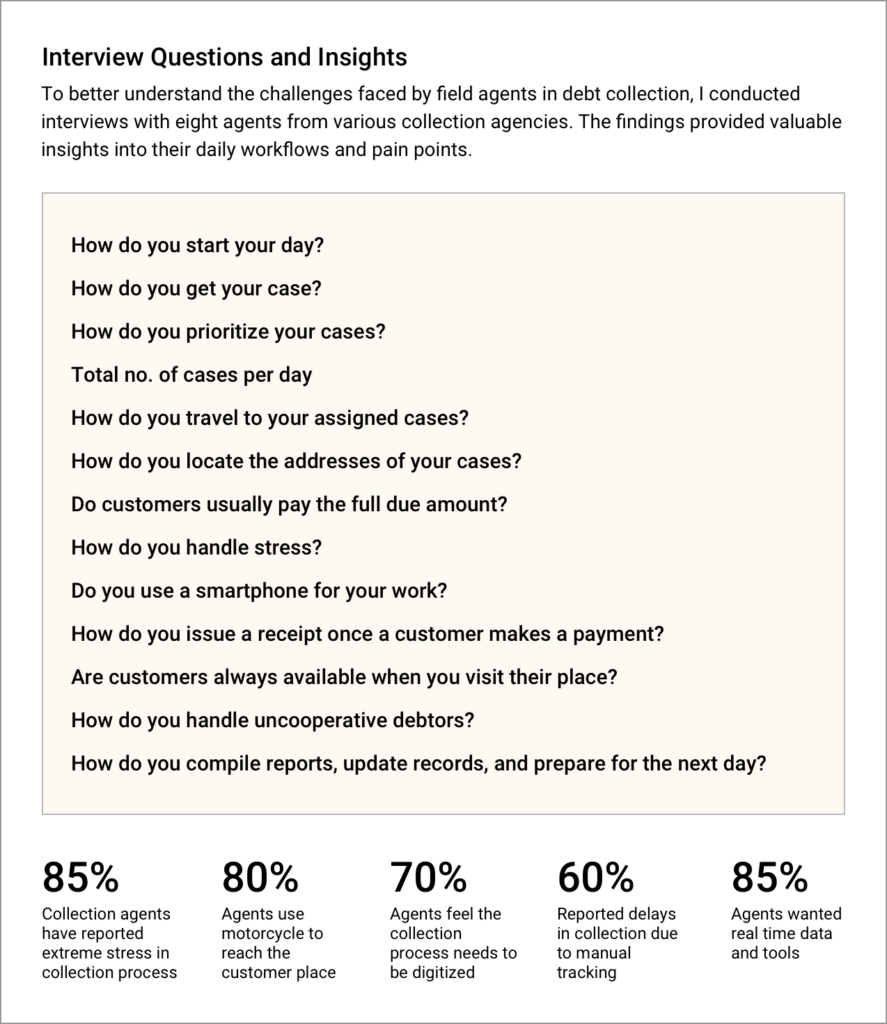
Before jumping into design, I conducted comprehensive research to understand the market, competitors, and user pain points.
User Research
Methods Used:
- User Surveys (to identify pain points and preferences)
- Interviews (to understand emotional and practical barriers to debt management)
- Usability Testing (to observe current behaviors with debt-tracking tools)
Key User Quotes from Interviews:
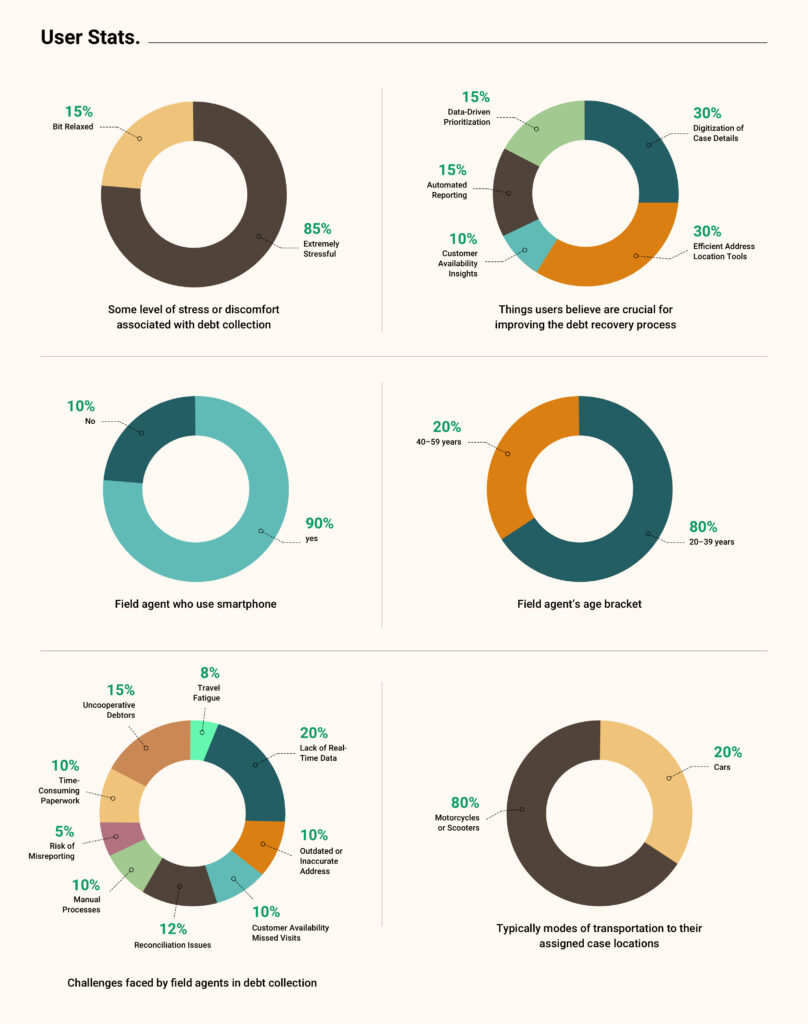
- Outdated addresses make finding borrowers difficult, and navigation tools are lacking.
- Manual case management is time-consuming due to excessive paperwork.
- Wasted visits occur when customers are absent or uncooperative.
- Lack of real-time data delays payment updates and reconciliation.
- Manual reporting increases the risk of errors and future issues.
- Stressful interactions and frequent travel cause exhaustion.
- No clear performance metrics or incentives affect motivation.
Competitive Analysis
I analyzed existing financial tracking apps to understand gaps in the market:
- Many apps were overwhelming with too many features.
- Few provided a simple, automated system for tracking payments.
- Existing apps lacked personalized insights or motivational nudges.
PROBLEM DEFINITION
Defining the Problem
Field agents in debt collection play a crucial role in recovering overdue payments through in-person interactions. However, their work is hindered by inefficient processes, manual tasks, and limited access to real-time data. These challenges result in delays, errors, and frustrations for both agents and their organizations. The lack of streamlined tools and transparent systems further exacerbates inefficiencies, leading to lower recovery rates and increased operational costs.
PROBLEM #1
Inefficient Borrower Location Processes
- Agents rely on printed stat cards containing borrower details, which are often outdated or incomplete.
- Manually searching for and organizing debtor information is time-consuming and error-prone.
- Locating borrower addresses is challenging due to inaccurate or insufficient address details.
Impact: Wastes valuable time, reduces productivity, and increases travel costs.
PROBLEM #2
Delays in Payment Updates
into the system
- Payments collected in the field are manually recorded and updated in the system at a later time.
- Delayed updates lead to reconciliation errors, false reporting, and mismatched records.
- Errors in payment records can damage borrower trust and lead to disputes or compliance issues.
Impact: Increases the risk of fraud, revenue loss, and miscommunication.
PROBLEM #3
Lack of Transparency and Accountability
- Manual tracking of agent activities makes it difficult for managers to evaluate performance or monitor progress.
- Agents struggle to provide real-time updates on completed tasks or payments collected.
- Lack of visibility into operations can lead to inefficiencies and potential misconduct.
- Chances of malpractice in the system.
Impact: Creates trust issues between agents, management, and customers.
GOAL SETTING
The Goal
To address the challenges faced by field agents, the aim is to design a system that streamlines debt collection workflows, reduces manual effort, and enhances the overall agent experience. This solution is guided by the following key goals:
GOAL #1
Simplify Borrower Location and Task Management
Provide agents with real-time access to accurate debtor details and integrate GPS navigation with route optimization to reduce the time and effort spent locating borrowers.
GOAL #2
Enable Real-Time Data Access and Updates
Facilitate instant syncing of payment records, automated receipt generation, and easy access to digital tools, ensuring efficiency and accuracy in field operations.
GOAL #3
Enhance Transparency and Operational Accountability
Introduce activity tracking, performance dashboards, and audit trails to improve visibility into agent workflows and foster trust between agents and management.
IDEATE
Affinity & Journey Mapping
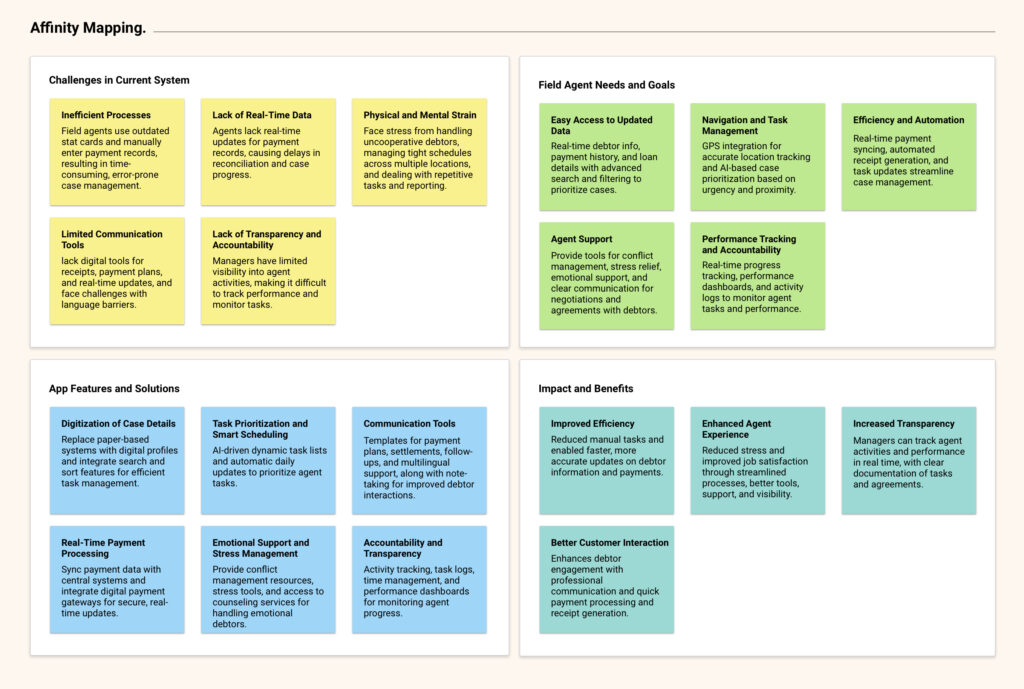
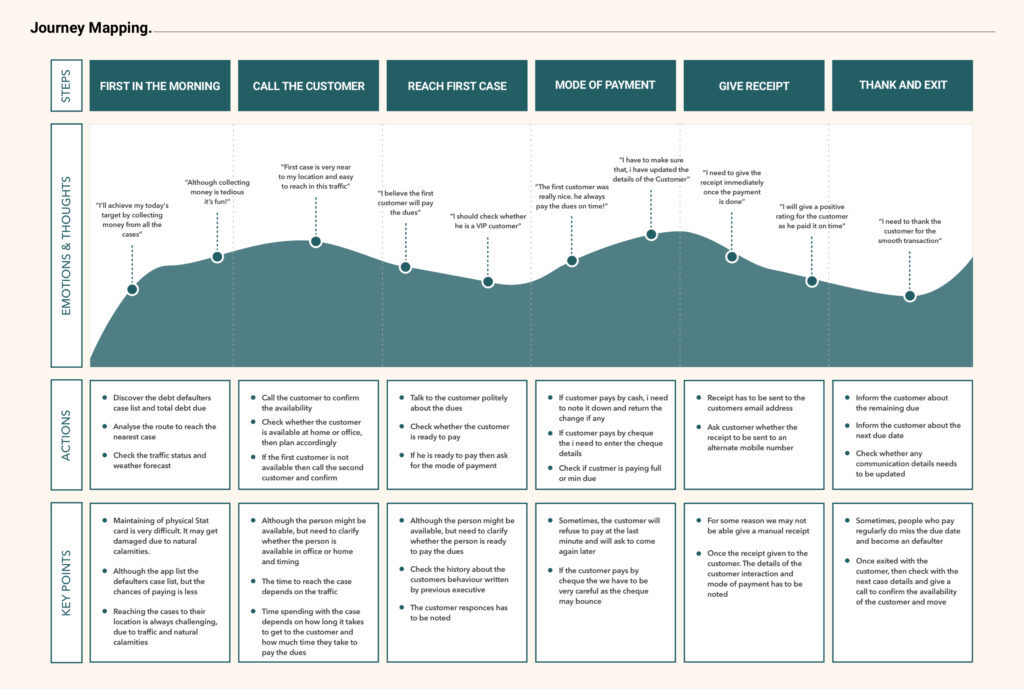
Affinity mapping was used to organize feedback from field agents into actionable themes, highlighting key challenges and opportunities for innovation. This, combined with a user journey map that outlines their tasks, pain points, and workflows, helped identify areas to improve efficiency in the debt collection process.
IA & WIREFRAMING
Structuring the Experience
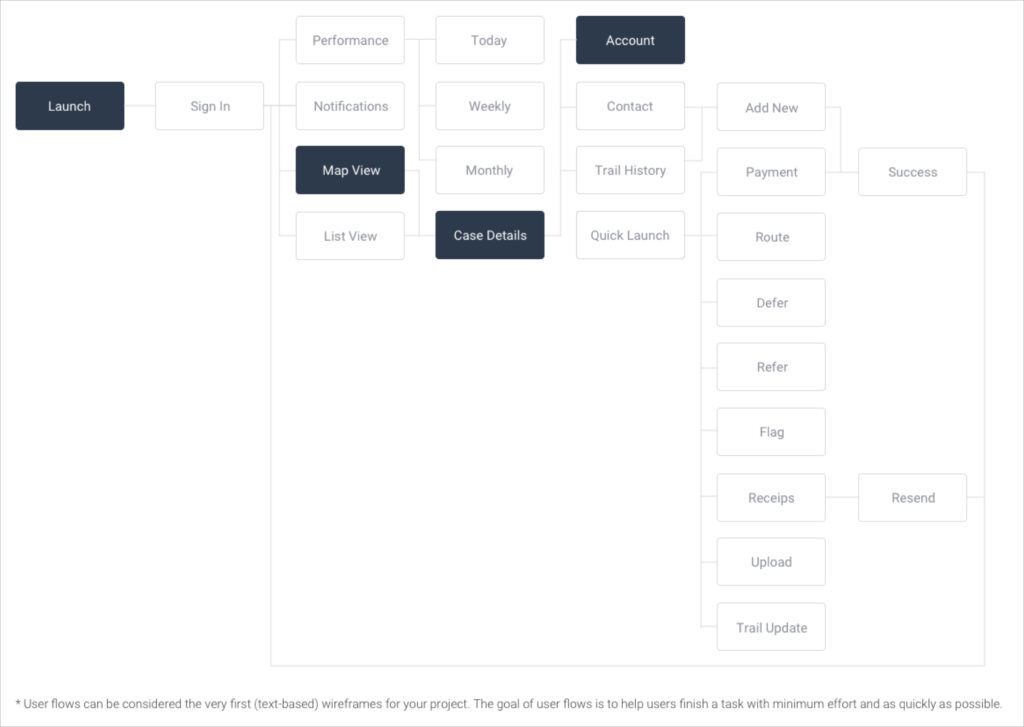
Based on research, I designed a streamlined information architecture with consistent task flows to minimize cognitive load, making the app feel natural, intuitive, and user-friendly:
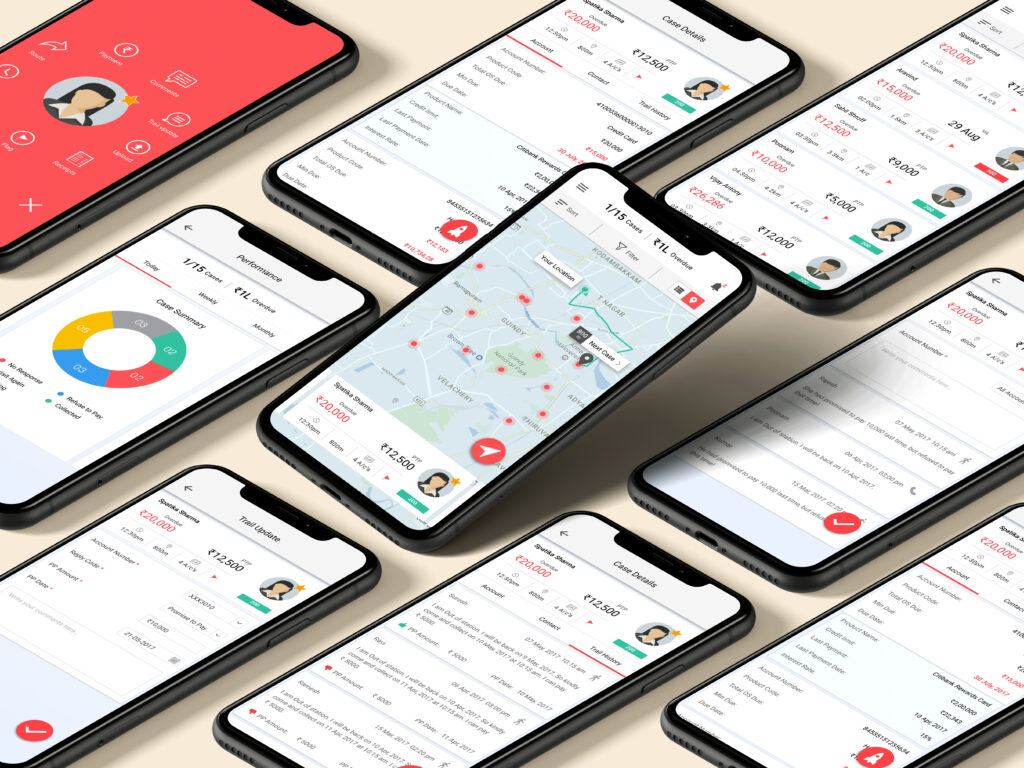
- Dashboard: Map/List view quick glance at cases debts, due dates, and progress
- Notifications: On new case refer and defer status, agency announcements
- Performance: Graphs to visualize total no. of cases/amount, bifurcation of the payment details and the incentive details for agents
- Case details: Quick glance at name, PTP, Total due, contact, account details and trail history.
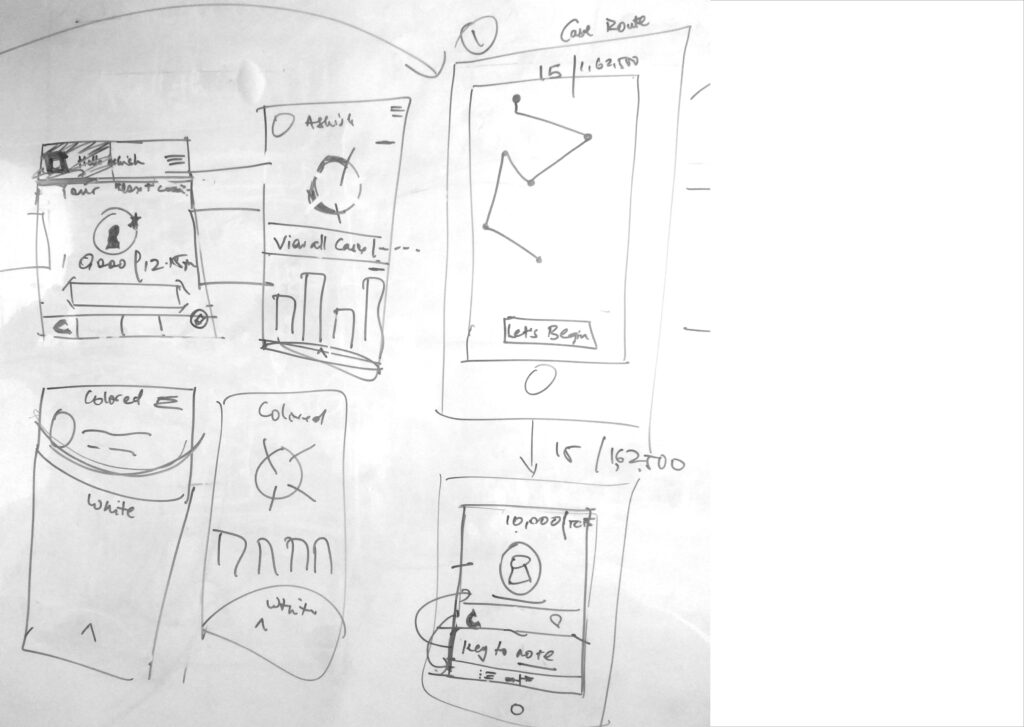
Paper Sketching & Wire-framing:
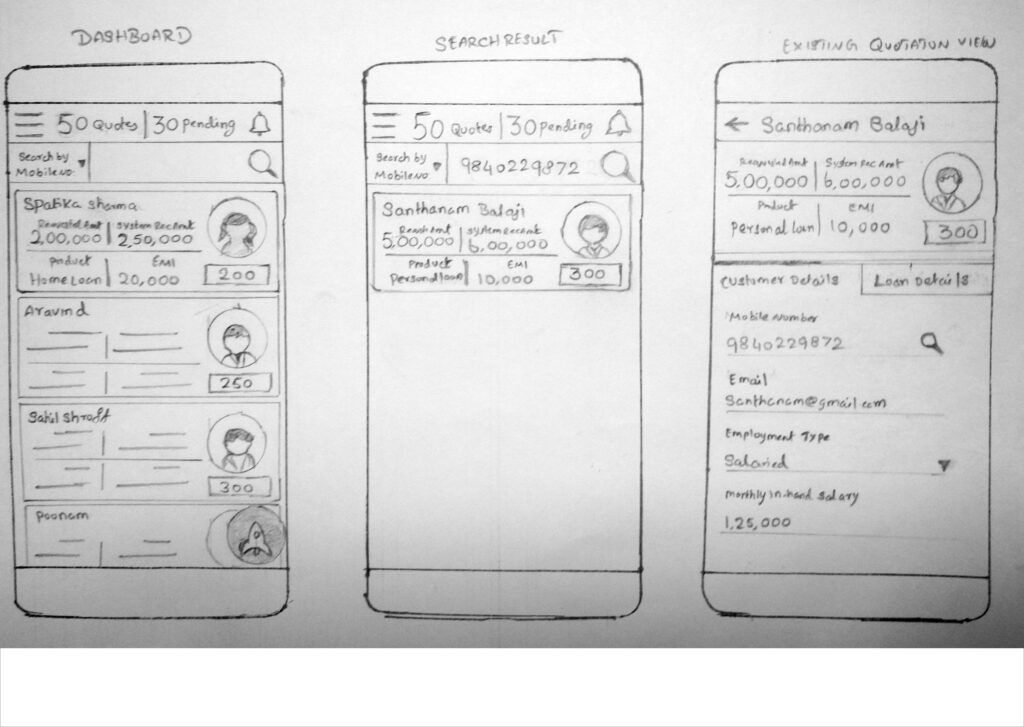
I began with paper sketches to explore layouts, focusing on simplified workflows, GPS integration, and real-time debtor info. After team validation, I refined them into wireframes, mapping user flows for borrower location, payments, and task management, ensuring a functional and user-friendly design for field agents.
- Focus: Clarity, simplicity, and a zero-friction onboarding process
- Testing: Conducted guerrilla usability testing with users to gather feedback
PROTOTYPE
First Concepts
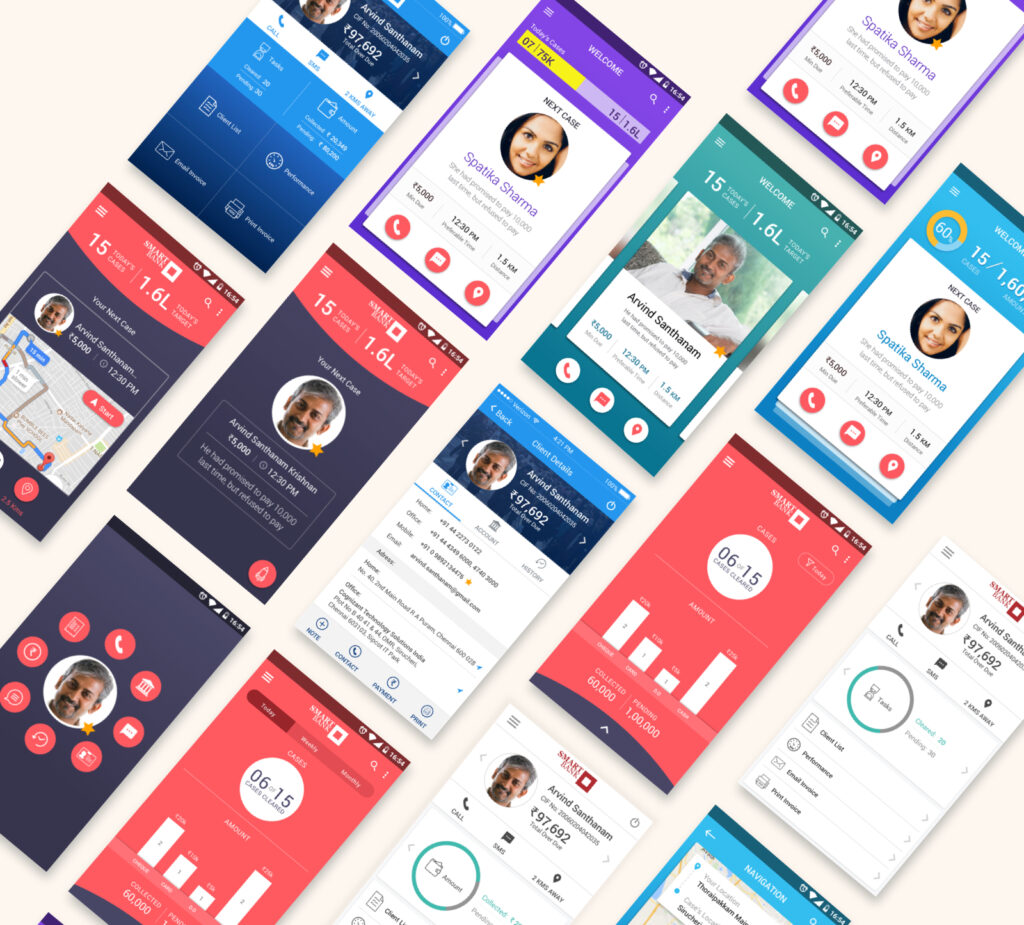
I initially designed concepts to display debtor details on the main screen and tested them internally and externally, which showed some improvement, but the team felt there was more room for innovation.
INSPIRATION
How Uber’s approach could suit my needs
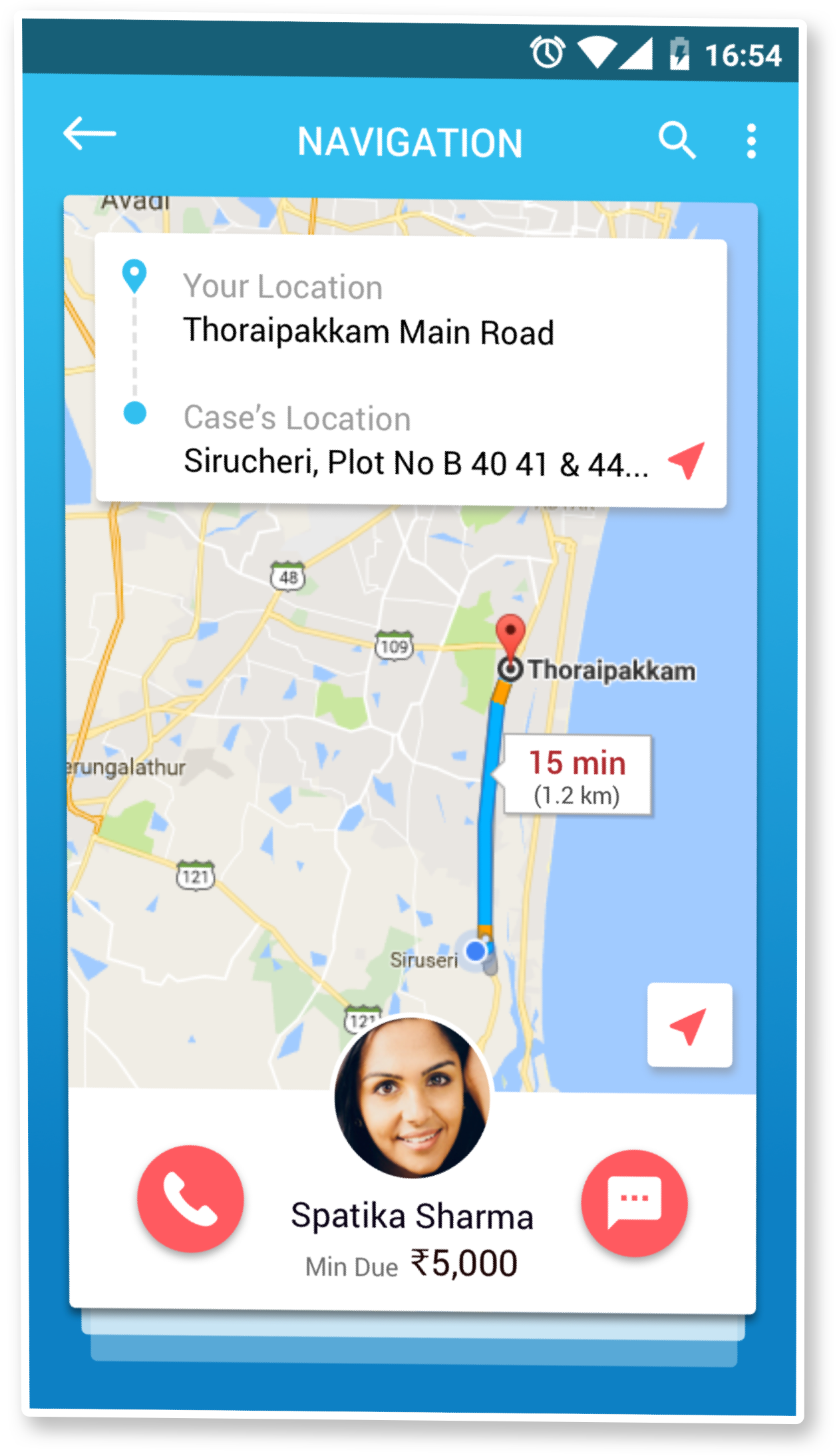
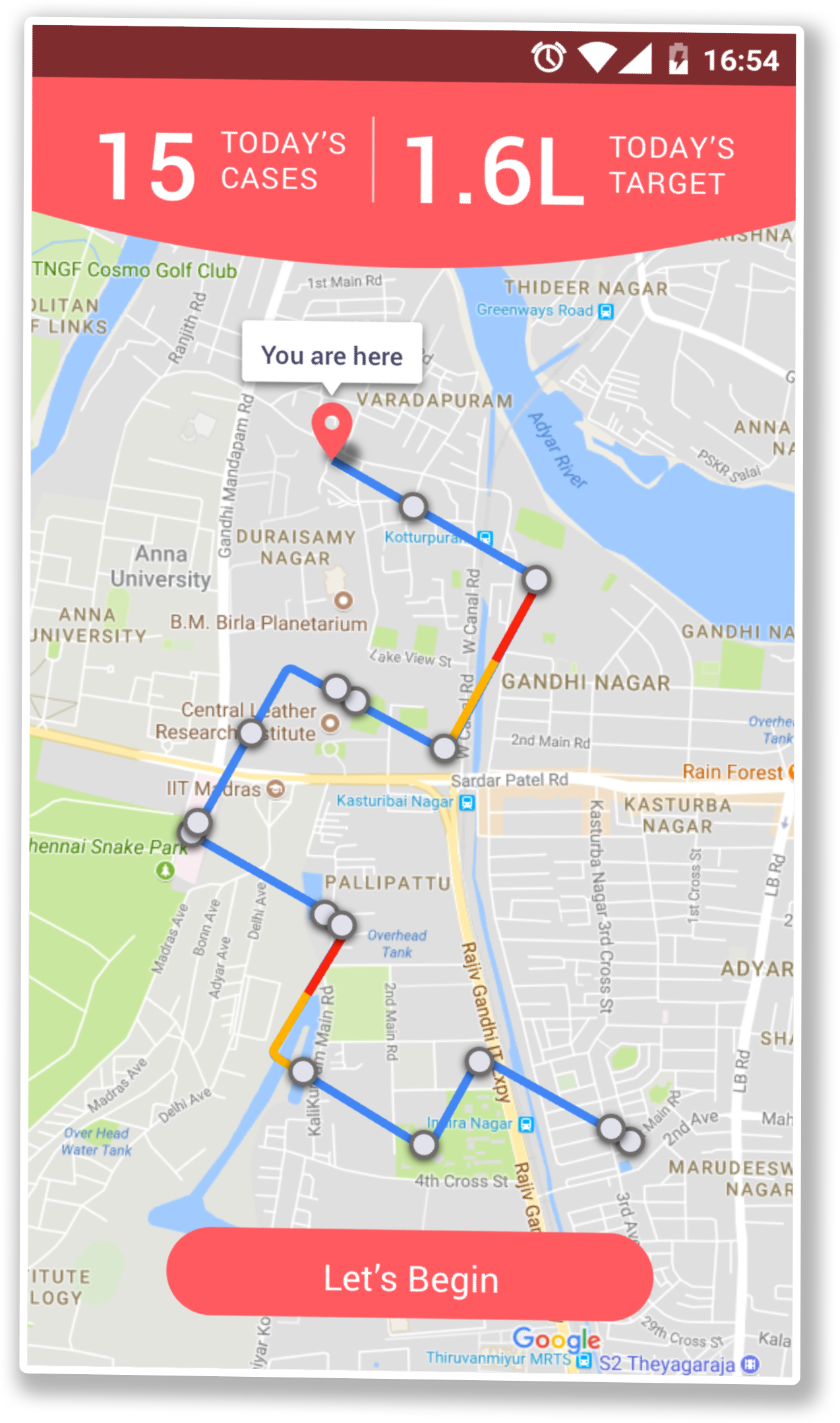
Drawing inspiration from Uber’s app, which uses real-time navigation to enhance transparency and user experience, I reimagined the approach to debt collection. By incorporating live tracking and real-time updates, we aimed to help agents locate debtors more efficiently and reduce uncertainty in the process.
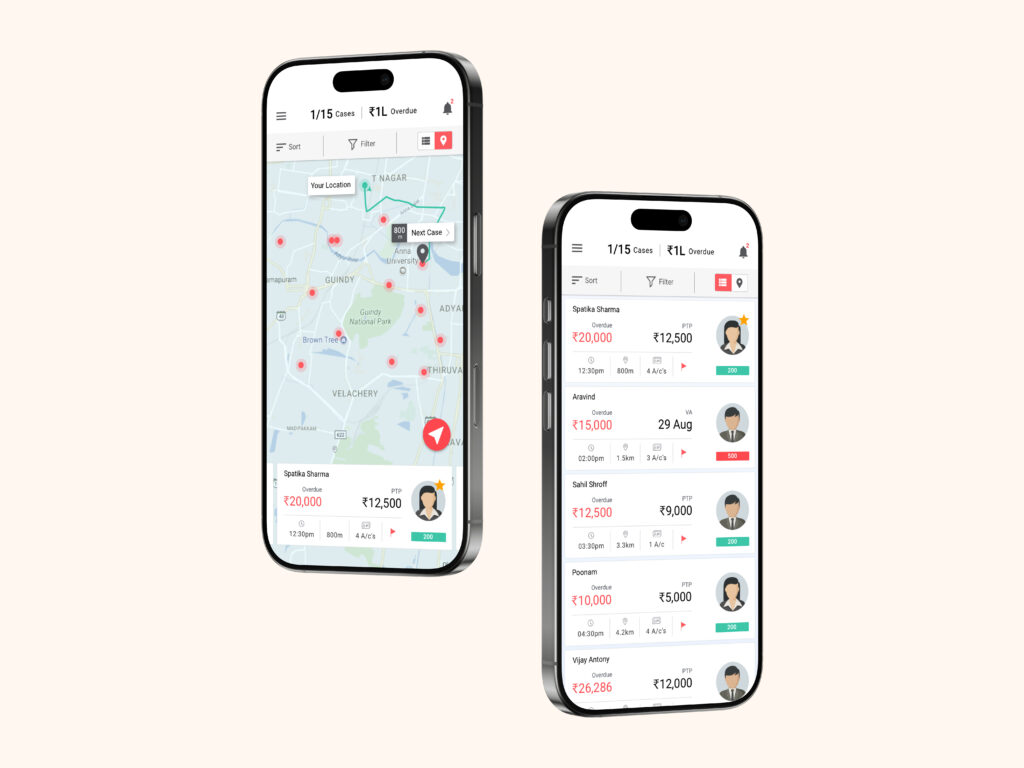
I quickly developed concepts and tested them, discovering that Uber-like navigation helped collection agents locate debtors efficiently. By displaying case location, overdue amount, promised payment, distance, number of accounts, and the debtor’s preferred meeting time, users responded positively to these changes..
CHALLENGE & SOLUTION
Smart Switcher for Map vs. List View
A key challenge was accommodating different user preferences—some collection agents preferred a list of debtors, while others used the map view exclusively. Many frequently switched between both views, but adding extra screens or clicks would disrupt efficiency.
To solve this, I introduced the “Smart Switcher”, a seamless toggle between Map and List views. The app remembers an agent’s preferred view and avoids unnecessary prompts, while allowing easy switching for those who need both, ensuring a frictionless and efficient user experience.
Final Prototype
TESTING
Usability Testing & Key Insights
To validate the prototype and ensure it met the needs of field agents, usability testing was conducted with eight collection agents from diverse backgrounds, including both tech-savvy users and those accustomed to manual processes. The agents tested key features such as real-time navigation, debtor details, and the Smart Switcher in real-world scenarios. They were asked to perform essential tasks, including locating debtors using GPS, switching between Map and List views, and recording payment updates in real time.
Testing focused on four key metrics: efficiency (time taken to locate debtors), usability (ease of switching between views), accuracy (error-free payment updates), and satisfaction (whether the prototype reduced workload and stress). Observations, post-task interviews, and surveys provided valuable insights, ensuring the design was functional, user-friendly, and aligned with field agents’ needs.
Usability Testing Results & Key Improvements
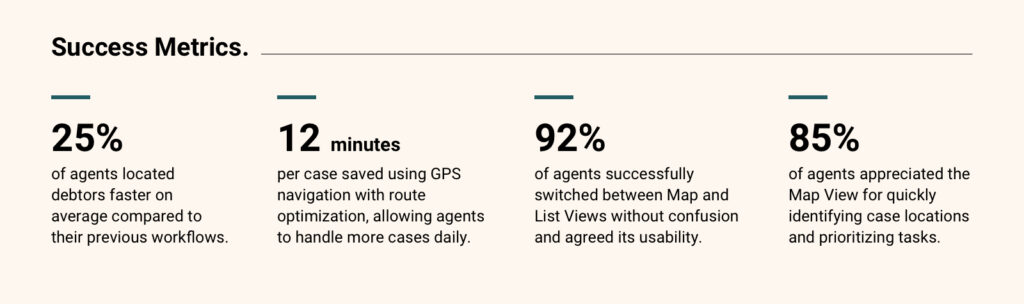
The usability testing showed significant improvements in efficiency, adoption, accuracy, and overall satisfaction among field agents. Agents located debtors 25% faster, with GPS navigation saving an average of 12 minutes per case, allowing them to handle more cases daily. The Smart Switcher streamlined workflows, enabling seamless switching between views, while real-time syncing reduced payment recording errors by 95%. Agents reported less stress, greater efficiency, and a strong preference for digital tools over manual processes.
Key Results:
- Improved Efficiency: 25% faster debtor location; GPS optimization saved 12 minutes per case.
- High Digital Adoption: 87% found the app intuitive; 75% planned daily use.
- Streamlined Workflows: 92% found the Smart Switcher useful; 85% relied on the Map View for prioritization.
- Reduced Errors: 95% drop in payment recording errors; no mismatched debtor info.
- Increased Satisfaction: 4.6/5 average rating; agents cited real-time updates and automation as stress relievers.
Post-Testing Adjustments:
Based on feedback, minor improvements were made to GPS clarity, offline syncing speed, and Smart Switcher animations before final rollout.
Final Results: Transforming Debt Collection with User-Centered Design
- 2x Business Conversions – Real-time GPS, route optimization, and debtor details doubled successful payment recoveries.
- 30% Faster Case Handling – Route optimization and real-time syncing boosted agent efficiency and daily productivity.
- 95% Error Reduction – Automated data syncing eliminated manual mistakes in payment recording.
- Streamlined Workflows – 92% of agents found the Smart Switcher improved task management.
- Increased Transparency – Real-time activity tracking and dashboards boosted manager satisfaction by 40%.
- Reduced Stress & Higher Satisfaction – 85% of agents felt more supported, with a 4.6/5 satisfaction rating.
- 80% Adoption Rate – Agents preferred the app over manual processes, ensuring long-term engagement.
- Positive Business Impact – Enhanced customer satisfaction, trust, and organizational reputation in debt recovery.